
What does IC/Non-IC rating mean?
IC (Insulation Contact): An IC-rated lighting fixture is designed and tested for direct contact with insulation.
Non-IC lighting fixture require a minimum clearance from insulation (typically at least 3 inches or more) to prevent overheating.
And while the distinction is simple, it actually has a significant impact on lighting fixture design, component manufacturing, and code compliance.
Why these ratings matter
The metal components used in your lighting fixtures play a critical role in achieving IC or non-IC ratings specifically:
Heat management
IC-rated fixtures must distribute and dissipate heat effectively to prevent fire hazards when surrounded by insulation. This requires:
- Properly designed metal IC boxes with specific thermal properties
- Sufficient IC box volume to prevent ‘hot spots” and to ensure heat dissipation
- Strategic ventilation design in some metal housing components
- Thermal barrier designs that prevent heat transfer to surrounding materials
Non-IC fixtures, on the other hand, have different thermal requirements, as they rely on the air gap between the fixture and insulation (or other elements in the ceiling plenum) for cooling.
UL1598 safety compliance
UL1598, the safety standard for luminaires, establishes specific requirements for IC and Non-IC fixtures and components. This means:
- IC boxes must pass rigorous temperature testing under simulated installation conditions
- Material selection is crucial (aluminum vs. steel considerations)
- Metal thickness specifications may differ between IC and Non-IC components
- Connection points between metal components must maintain thermal integrity
Difference between IC and Non-IC components
| Feature | IC | Non-IC |
| Heat dissipation | Enhanced heat sink designs | Standard heat management |
| Volume/Venting | IC box volume consideration /strategic vent placement | More open venting allowed |
| Material thickness | Often requires thicker gauge material | Can use lighter gauge metal |
| Design complexity | More complex thermal barriers | Simpler designs possible |
| Manufacturing cost | Typically higher | Usually lower |
| Testing requirements | More extensive | Less stringent |
IC lighting design considerations
When designing metal components for IC fixtures, you must consider:
- Metal selection: Aluminum’s thermal conductivity makes it excellent for heat dissipation, while steel offers strength and fire resistance.
- Gauge thickness: The thickness of your metal components impacts both heat management and structural integrity, while must also meet UL minimum thickness requirements (e.g. 0.026” minimum IC Box thickness for ferrous metal)
- Ventilation design: Strategic placement of louvers or other ventilation features can significantly impact thermal performance.
- Surface finishing: Certain finishes can enhance or impede heat dissipation.
- Assembly methods: How components connect affects thermal transfer between parts.
What lighting components needs to be IC rated?
The specific components of recessed lighting fixtures that need to be IC-rated include:
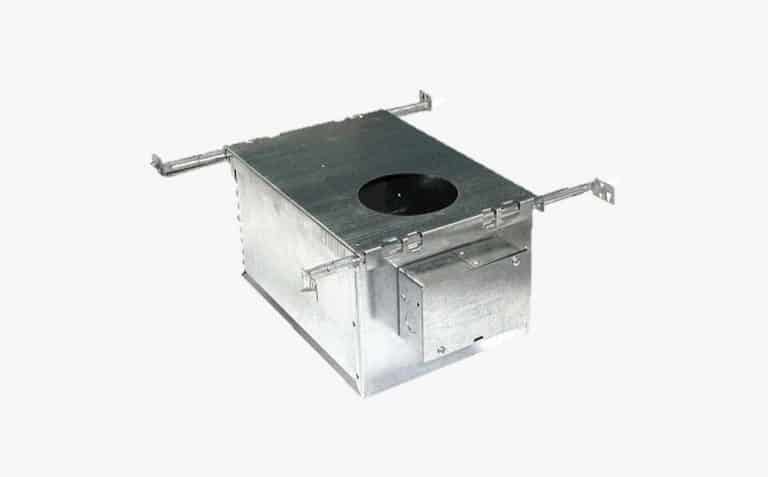
- IC boxes: The primary housings designed to contain heat and prevent fire hazards when surrounded by insulation.
- Driver boxes: If located within the insulated space, driver boxes must be designed to manage heat effectively.
- Plaster frames: While plaster frames generally support the fixture, if they are part of an IC-rated assembly, they form part of the enclosure, so they fall under the same requirements as the IC box.
- UL1598 assemblies: Any metal or plastic housing that directly contacts insulation must be rated to handle thermal conditions safely.
Chicago Plenum considerations
For lighting components used in plenum spaces (such as in Chicago where building codes are particularly strict), additional requirements apply:
- No open holes permitted
- Some materials are prohibited in plenum-rated fixtures
- Special coatings or treatments may be needed
- Additional testing for smoke and flame spread
At Tripar, we manufactured lighting components for Chicago Plenum applications, ensuring compliance with these specialized requirements.
Airtight IC requirements
Many jurisdictions now require airtight* IC lighting fixtures to prevent conditioned air from escaping into attic spaces. This adds another layer of design considerations:
- Gaskets and sealing components may become necessary
- Metal components must be designed with precise tolerances
- Connection points need specific designs to maintain airtight integrity
- Custom metal forming techniques may be required
*Not fully airtight as the name implies, but rather reduced airflow according to certain specifications. For example, 2 cfm under pressure (vacuum) of 1.57lbs/ft², ref. Florida Building Code
Selecting the right products
Choosing between IC and Non-IC rated lighting products depends on:
- Target market: New construction often favors IC-rated fixtures
- Building codes: Consider local codes in your distribution areas
- Cost/benefit analysis: Weigh the production cost versus performance benefits
- Thermal management requirements: Particularly important for LED fixtures
How Tripar supports IC and Non-IC lighting projects
Tripar is the largest supplier of recessed lighting components in North America. We understand the nuances between IC and non-IC design* and manufacturing. Many of our metal components are found in thousands of lighting fixtures, illuminating millions of buildings in North America.
Whether you need IC boxes, bar hangers, plaster frames, UL1598 assemblies, or other components for your commercial lighting needs, our team can help ensure they meet all relevant standards and perform optimally in their intended applications.
*See our Recessed Downlight Guide sections 5.2-5.8.