
What is CNC machining?
CNC machining is a subtractive manufacturing process.
It starts with a solid block, bar, plate, or casting, then removes material until the final shape is made. It’s usually done by milling, drilling, turning, boring, or tapping processes.
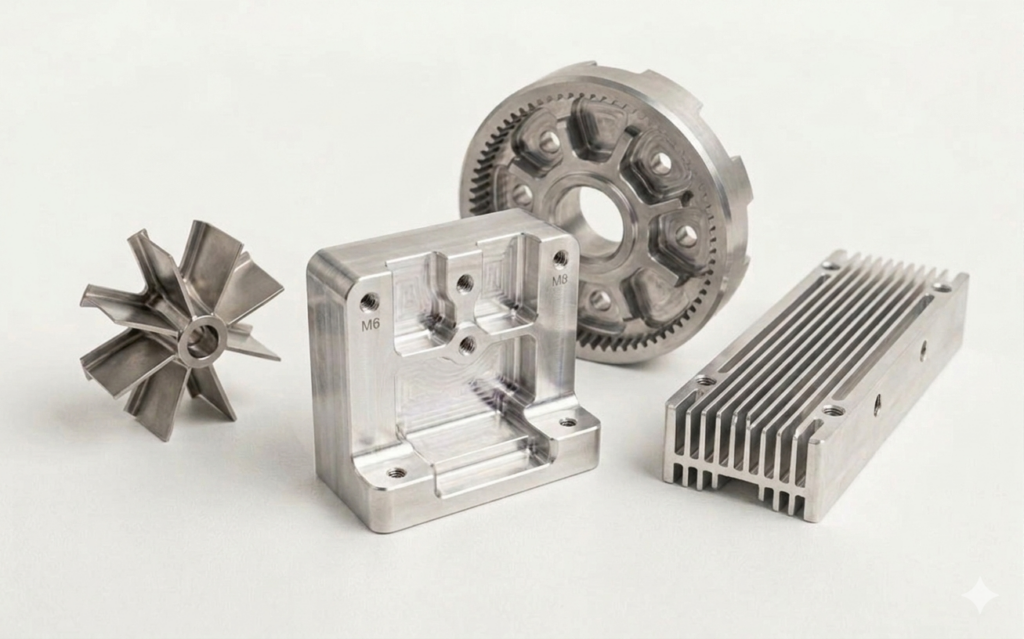
Machining is ideal for:
- Tight dimensional control
- Complex 3D geometry
- Variable material, wall, & feature thicknesses
- Threaded holes
- Pockets or precision surfaces
- Features that can’t be made from sheet metal
- Low to moderate volumes (typically 1-1000; more than this is where casting or diecasting may be more appropriate; think engine block; cast then precision machined)
Common parts include:
- Bushings
- Engine parts (crankshafts, valves, etc.)
- Tooling components
- Precision parts
- Shafts
What is CNC fabrication?
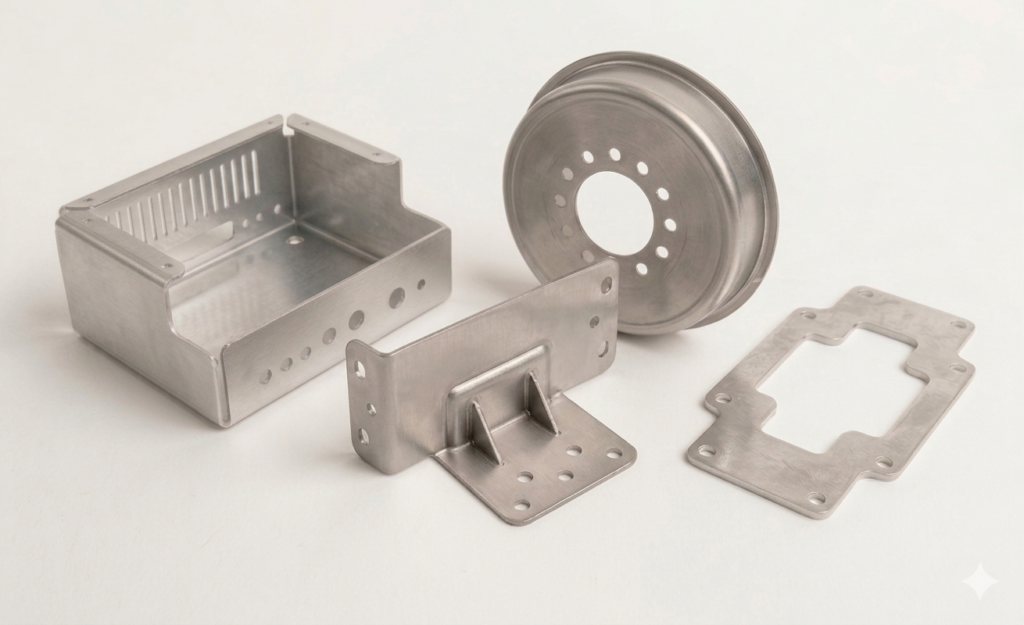
CNC fabrication is a manufacturing process turning sheet metal into finished products and assemblies. As a result, parts generally have a constant material or wall thickness.
The material can be laser cut, punched, bent, formed, stamped, or assembled depending on the part’s design. It is commonly used for residential, commercial, and industrial applications.
Common parts are:
- Brackets
- Covers
- Trays
- Panels
- Enclosures
- Lighting components
- sheet metal assemblies
The key differences
The difference is part thickness, but there’s a lot more.
| CNC fabrication | CNC machining | |
| Material | Sheet metal, constant material thickness | Solid metal & metal plates, machined to variable thickness & geometry |
| Processes | Cutting, bending, forming, rolling, stamping | Milling, drilling, turning, boring, tapping |
| Applications | Sheet metal parts and assemblies | Precision 3D features or thick parts |
| Throughput | Faster for production volumes | Slower per part / run |
| Cost | Cheaper | More expensive |
Why the cost is different
Typically, a CNC machined part is more expensive as it requires more material and machine cutting time. That’s not a problem for complex machined parts.
However, it’s significantly more expensive when that same function can be achieved with sheet metal. For example, a simple cover, bracket, or enclosure often doesn’t need to be carved from solid metal.
Which process is right for you?
It really depends on the part’s geometry, features, thickness, tolerances, and production volumes.
Choose CNC machining when your parts requires complex 3D geometry, thick sections, precision surfaces, or features that would be difficult (or impossible) to produce with sheet metal.
Choose CNC fabrication when that same part can be achieved with sheet metal and where cost effectiveness is a top priority.