
What is sheet metal thickness?
Sheet metal thickness is under ¼ (0.25”). Anything thicker is called a plate.
In North America, we measure it in two ways:
- Gauges (ie. 14 GA) – industry standards
- Inches (ie. 0.0747″) – precise measurements
Europe and Asia primarily use the metric system, thus millimeters (mm).
Understanding sheet metal gauges
Oddly, the gauge system works in reverse. The higher the gauge number, the thinner the metal.
For example, for cold-rolled steel (CRS), 20 gauge (0.0359″) is much thinner than 14 gauge (0.0747″). While this might seem counterintuitive, it is the standard in the industry.
A common mistake
Gauge thickness varies by material type.
A 14-gauge steel (0.0747″) is thicker than 14-gauge aluminum (0.0641″). Same gauge, different thicknesses.
To avoid any confusion, always specify the material type and gauge (eg. Stainless Steel 24 GA) when quoting.
CRS sheet metal thickness chart
*Nominal thickness; same gauge number in different metals = different thicknesses.
| Gauge | Inches* | Applications | Materials |
|---|---|---|---|
| 7 | 0.1793 | Heavy structural components | Hot-rolled steel |
| 10 | 0.1345 | Machine guards, heavy brackets | Cold-rolled steel, stainless steel |
| 12 | 0.1046 | Sturdy enclosures, frames | Steel, stainless steel |
| 14 | 0.0747 | Medium-duty brackets, panels | Steel, aluminum, stainless steel |
| 16 | 0.0598 | Light fixtures, cabinets | Steel, aluminum |
| 18 | 0.0478 | HVAC components, boxes | Galvanized steel, aluminum |
| 20 | 0.0359 | IC boxes, electronic enclosures | Cold-rolled steel, aluminum |
| 22 | 0.0299 | Light-duty enclosures | Galvanized steel |
| 24 | 0.0239 | Ductwork, flashing | Galvanized steel, aluminum |
| 26 | 0.0179 | Computer cases, light covers | Various |
| 28 | 0.0149 | Electronics shielding | Various |
| 30 | 0.0120 | Decorative elements | Various |
Material tolerances
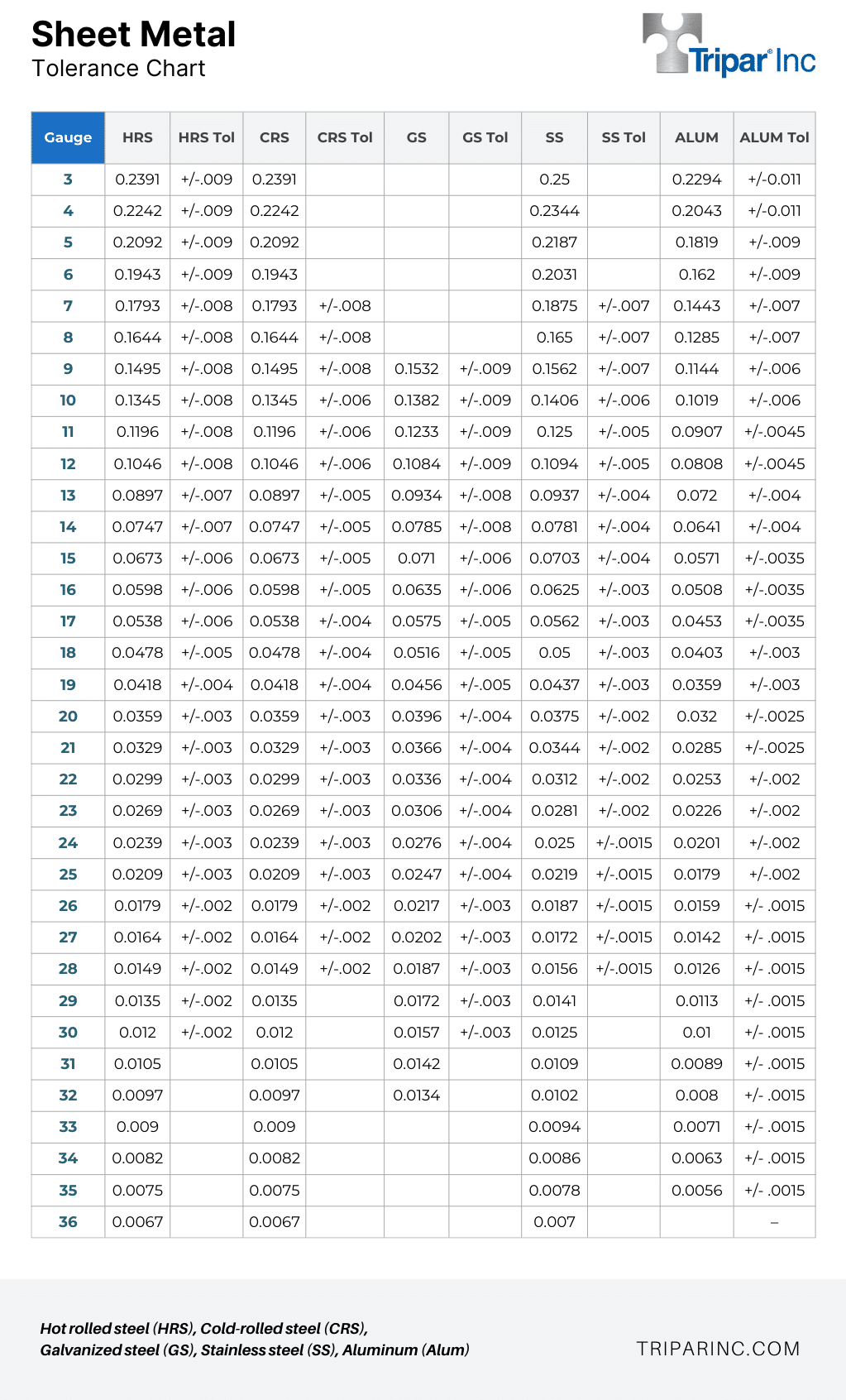
Every material has its own inherent thickness tolerances. Failing to account for these subtle differences can lead to inaccuracies in your product designs or assemblies.
For example, 14 GA steel (0.0747″), the actual thickness can vary by ±0.007″ in standard production. This means your material could range from 0.0677″ to 0.0817″ thick. Here’s how much tolerance variations to expect based on various materials and thicknesses.
Sheet metal tolerance table
Fabrication tolerances
When parts are manufactured, additional tolerances come into play based on fabrication processes:
- Forming and bending: ±0.010″ to ±0.030″ depending on complexity
- Hole locations: ±0.005″ to ±0.015″ typical
- Overall part dimensions: ±0.015″ to ±0.060″ based on size
- Feature-to-feature: ±0.010″ to ±0.030″ typical
These tolerances are general guidelines and vary based on part design, tooling, and manufacturing method.
How to select the right thickness
When picking a thickness, consider:
- What material is required or are you considering?
- How strong does it need to be?
- Does it need to be bent or shaped? (Thinner material is easier to shape.)
- What’s your budget for each part? (Thicker metals typically cost more.)
Sheet metal thickness standards
Most sheet metal fabrication projects fall into these ranges:
- 10-14 gauge: Heavy-duty structural parts
- 16-20 gauge: General industrial & commercial parts
- 22-26 gauge: Light-duty and residential applications
Common applications by thickness
Very thin (26-30 gauge)
- Ductwork
- Flashing
- Simple brackets
- Computer enclosures
- Electronics shielding
Medium (16-24 gauge)
- Light fixtures
- Junction boxes
- Electronic enclosures
- HVAC components
- Driver boxes
Thick (10-14 gauge)
- Heavy-duty brackets
- Structural components
- Machine guards
- Support frames
It’s worth noting that odd-numbered gauges (e.g., 7 GA, 19 GA, 27 GA) exist, but they are far less accessible from service centers than even-numbered gauges. Unless your project requires over 100 tons of the same gauge (where you or your service center can order direct from a mill), avoid the former.
Money-saving tips
- Don’t use thicker metal than you need.
- Stick to standard gauges (even numbered gauges) where possible.
- Consider ribbing or bends to add strength instead of using thicker metal.
- Talk to a manufacturer about your specific application.