
What is Metal Spinning?
Metal spinning, also known as spin forming, is a metal forming process where a flat metal disc (called a blank) is rotated at high speed on a spinning machine, very similar to a lathe; done manual or by a CNC machine. A skilled operator (or a CNC spinning machine) uses specialized rolling tools to gradually shape the spinning metal against a mold held mandrel or chuck, whose profile mimics the desired shape.
Think pottery on a wheel but with metal instead of clay. Pressure applied to a rotating metal disc will form the metal until it conforms with the underlying mold or form.
Video credit: rebeccamortimer1
Spinning Overview
- Manual spinning – requires skilled operators
- CNC spinning – requires costly machines
- Little to no tooling costs – only requires a mandrel or form
- Flexible production – can produce one-off parts or small batches in days
- Good for prototypes – due to low tooling cost
- Good for round shapes only – e.g. pots
- Material thickness typically remains constant throughout the part
What is Deep Draw Stamping?
Draw & deep draw stamping is an automated sheet metal forming process that uses a punch and die to transform flat metal blanks into three-dimensional parts. The metal blank is placed over a die cavity, and a punch forces the metal into the die, creating hollow parts that can have significant depth.
The term “deep drawing” applies when the depth of the formed part is greater than its diameter or size. This process is highly automated and runs continuously once set up properly. Draw stamping is more versatile than spinning when it comes to producing non-symmetrical features and creating various features.
Deep Draw Stamping Overview
- Automated process with minimal labor
- Higher tooling costs than spinning – requires custom dies
- Faster production times once the tooling is complete
- Same consistency across thousands and millions of parts
- Material thickness can vary through the part (typically thins at corners)
- Better surface finish than metal spinning that can leave spinning marks
- Better dimensional accuracy (much tighter than spinning)
- Low unit costs over mid to high annual production volumes
Head-to-Head Comparison
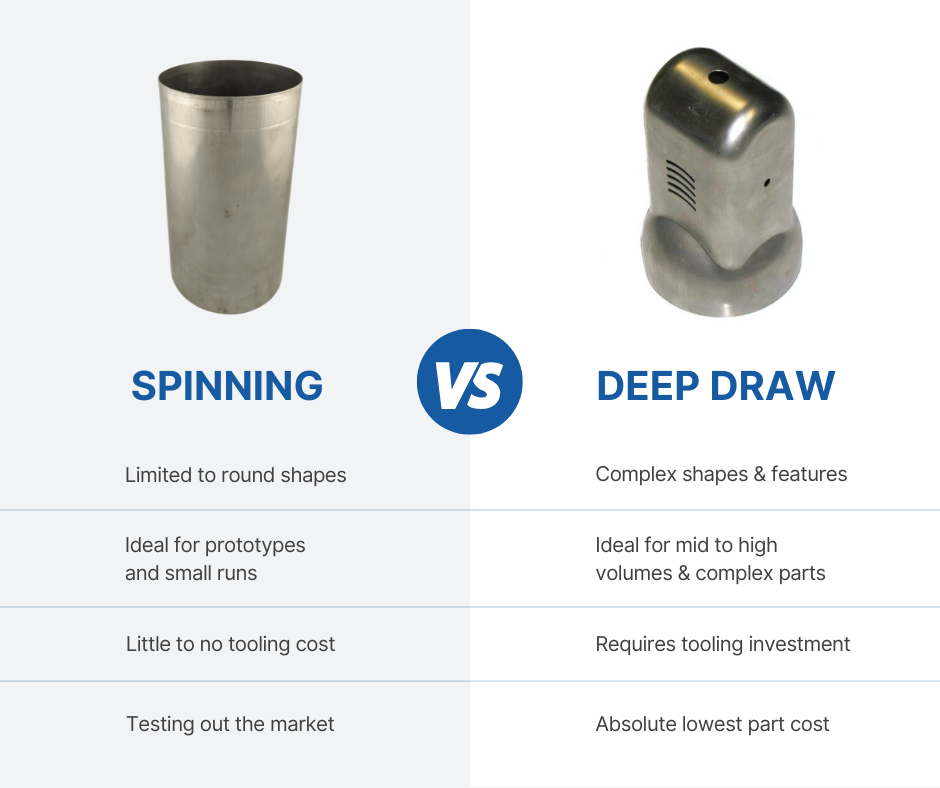
This picture below explains the main differences. The rest of the details is about volumes, tooling, part complexity, material, quality & consistency comparing both processes.
Annual Volumes
Metal Spinning for Low Volumes (1-3,000 annual units*)
- No expensive tooling
- Quick setup and changeover
- Cost-effective for prototypes and small annual runs
- Can start production immediately
Deep Draw Stamping for Mid to High Volumes (3,000+ annual units*)
- Need a custom die to be built first
- Faster production times (seconds vs. minutes)
- Consistent quality without operator variability
- Lower part costs than metal spinning
- Requires little to no labor costs
*This heavily depends on part size and complexity.
Initial Investment
Metal Spinning
- Low startup costs ($500-$2,000 for mandrel/form)
- No complex tooling required
- Quick turnaround from design to first part
Deep Draw Metal Stamping
- High initial tooling costs ($5,000-$50,000+ for dies)
- Longer initial lead times to build the tooling (4-16 weeks)
- Requires press with adequate tonnage
Part Complexity
Metal Spinning
- Excellent for symmetrical shapes (cylinders, cones, hemispheres)
- Can create complex curves and compound angles
- Often easy to modify designs without costly tooling changes
- Limited to rotationally symmetric parts
Deep Draw Metal Stamping
- Great for parts with flanges, tabs, mounting features, etc
- Can incorporate multiple forming operations in one stroke
- Create symmetrical & non-symmetrical shapes
- Better for parts requiring fine surface finish
- Better for parts requiring tight tolerances
Material Considerations
Metal Spinning
- Works well with most ductile metals (aluminum, steel, stainless, copper)
- Material thickness remains relatively constant
- Less material stress during forming
Deep Draw Metal Stamping
- Excellent for thin-gauge materials
- Material draws and thins during forming
- Better control over final wall thickness
Quality and Consistency
Metal Spinning
- Quality depends on operator skill (unless CNC spun)
- Some variation between parts is normal
- Good for custom or artistic applications
Deep Draw Metal Stamping
- Better overall surface finish
- Tight tolerances achievable (±0.005″)
- Extremely consistent part-to-part quality
- Repeatable dimensions across production runs
When to Choose Metal Spinning
Metal spinning is better for:
- Fast turnaround – Need parts in days, not in weeks
- Low to medium volumes – Typically under 3,000 pieces annually
- Prototype development – Test your design before committing to tooling
- Custom / artistic shapes – Unique designs that won’t be mass-produced
- Design flexibility – May need to modify the design during development
When to Choose Deep Draw Stamping
Deep draw stamping is better for:
- Consistent quality across all parts
- Tight tolerances for critical applications
- Fine surface finish – doesn’t leave spinning marks
- Complex geometries with non-symmetrical features
- Mid to high-volume production (Typically 3,000+ pieces and more)
- Long-term production – Will be making the same part for years
- Cost effective parts – Need the lowest possible unit cost
- Faster production – repeatable parts in seconds
Cost Analysis: Break Even Points
The break-even points between metal spinning and draw stamping depends on many factors. Actual costs are based on part size, complexity, annual volumes and vary widely. Here are two examples to show you the math.
Cylindrical part
- Break-even: Typically 3,000-5,000 pieces
- Metal spinning: e.g. $15-25 per part (low volumes)
- Draw stamping: Same part as above; $3-5 per part (high volumes) + tooling costs
Complex metal part
- Break-even: Typically 5,000-10,000 pieces
- Metal spinning: e.g. $25-50 per part (low volumes)*
- Draw stamping: Same part as above; $5-12 per part (high volumes) + tooling costs
*Assuming the complex shape can even be done by spinning
Hybrid Approach: Best of Both Worlds
At Tripar we generally recommend a hybrid approach for most clients:
- Start with metal spinning for prototypes and small production runs of symmetrical round or cylindrical shaped parts
- Transition to draw stamping as your volumes increase, you have stable products, and when you need complex shapes & features that metal spinning can’t form
This hybrid approach allows you to go to market quickly with metal spinning, reduce costs, and optimize your part as production volumes grow. However, depending on the part size, shape and features, sometimes it can only be produced by draw operations.